Dunwich 2008
Why Dunwich?
The UK coastline is constantly changing and no more so than along the erodible geology of the east coast. Over the last 11,000 years post-glacial sea level rise has resulted in both inundation and coastal erosion. Large areas of former land have been inundated and now lie beneath the sea. Organised towns and villages, with stone buildings developed during the Roman settlement, and in the later period of Saxon rule. However the largest expansion of stone built structures occurred after the Norman invasion. Large scale church building In the 12th - 15th century resulted in most settlements containing at least one large stone structure. Coastal erosion over the last 800 years has led to the loss of many such settlements, including churches at Cromer and Eccles on the Norfolk coast, Kilnsea and Ravenscar on the Humberside coast, Selsey on the south coast, and Dunwich on the Suffolk coast to name a few. The decision to focus on Dunwich is summarised in the following points:
- Largest and most significant of the more recent settlements lost to coastal erosion and inundation.
- Relatively well documented (Pre-conquest - present)
- Location well documented and mapped back to 1587 AD.
- Opportunity to demonstrate heritage preservation of a medieval site in a moderate energy coastal zone.
- Variable environment of preservation (estuarine inundation and cliff recession)
- Differential inundation history of similar structures (churches) over 800 years.
- Unknown geography of site pre-1587 including large early medieval harbour.
- Difficult and challenging site conditions demanding novel application of existing technology.
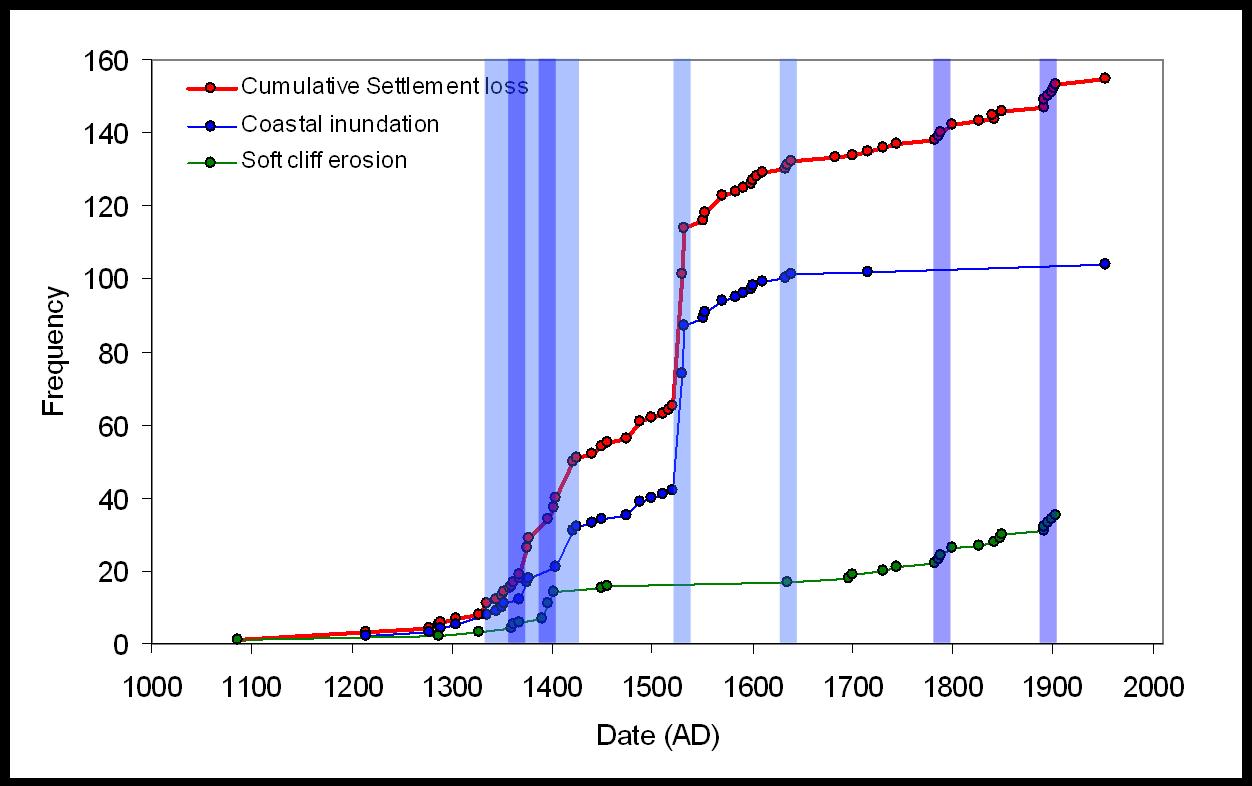
Figure: Loss of settlements around the southern North Sea over the last 1000 years. Distinct phases are apparent that appear to link to periods of climatic deterioration.